Terms
What par in golf means
Par is the number of strokes a scratch golfer is expected to take on a hole or a full round, set hole by hole mainly by yardage, and used as the baseline every other score is measured against.
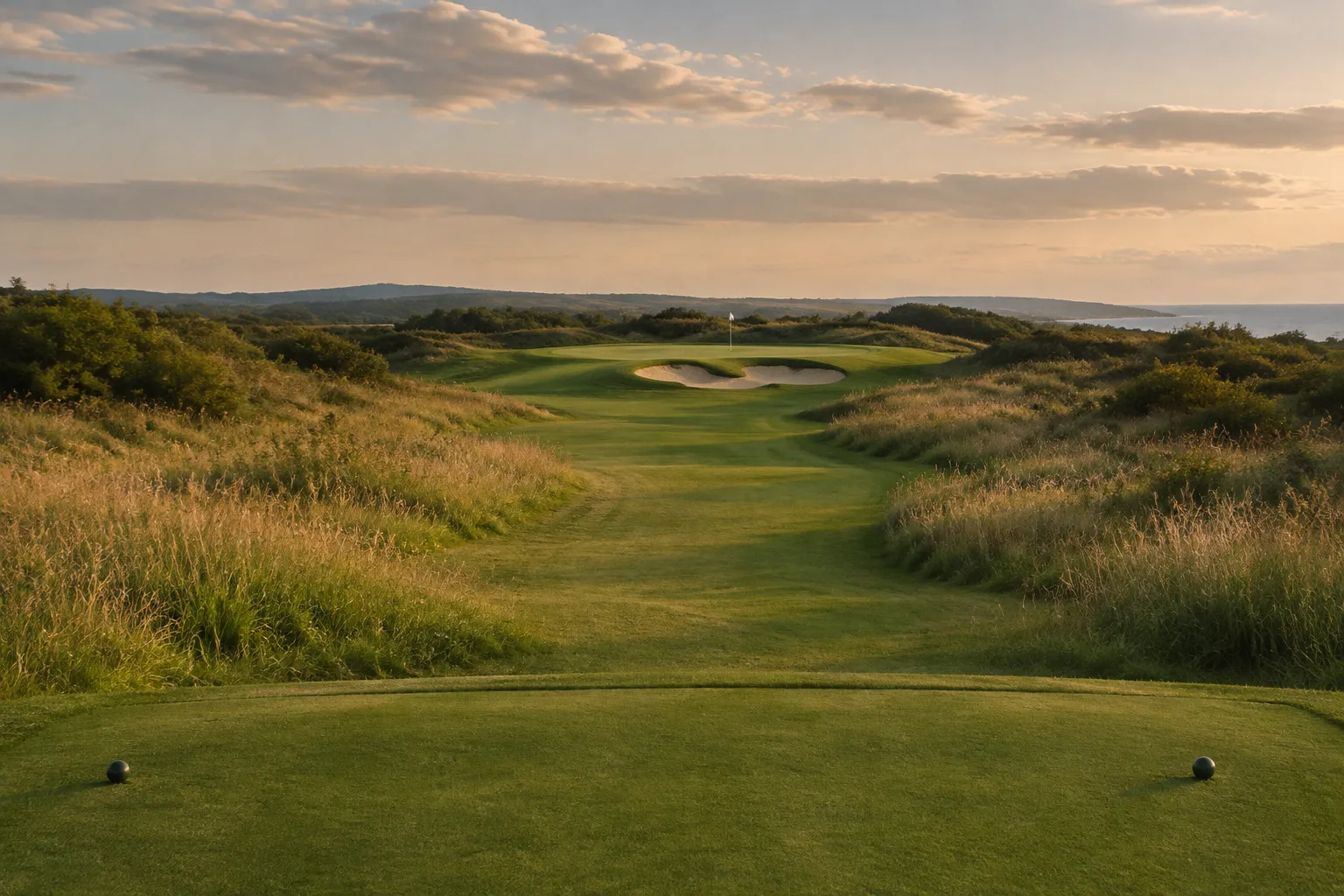
Each hole carries its own par, set before you ever play it and based mainly on length: short holes are par 3, mid-length ones par 4, and the longest par 5, with the course's overall par simply the sum of all eighteen. Appendix F of the Rules of Handicapping is where that is set out, and it says par should be established by hole length first, then adjusted for playing difficulty such as elevation changes, forced lay-ups and prevalent wind, and that par "reflects the score a scratch player is expected to score on a given hole". Everything else in the scoring vocabulary hangs off that baseline: a bogey is one over it, a birdie one under, and so on in both directions. Par doesn't move with the weather or the wind on the day; it's fixed to the course. It's also the number every golfer secretly measures their whole round against, whatever the handicap on the card. Put that round on the wall with our golf gift ideas.

How long is a par 3, 4 or 5?
Length does most of the work. These are the usual yardage guidelines, and individual courses move a hole up or down a par when the ground, the wind or a dogleg changes how it really plays.
| Hole | Men, roughly | Women, roughly |
|---|---|---|
| Par 3 | up to 250 yards | up to 210 yards |
| Par 4 | 251 to 470 yards | 211 to 400 yards |
| Par 5 | 471 to 690 yards | 401 to 575 yards |
Why most courses are par 70, 71 or 72
Add up eighteen holes and you land on the course par. The usual mix is four par 3s, ten par 4s and four par 5s, which makes 72, and a course with one par 5 fewer is a 71. It is not a rule, just what has settled as a good, balanced round. The idea behind a par hole is simple: two shots to reach the green on a par 4, and two putts. Reach it a shot sooner and you have a chance of a birdie.
Par is not the target for most of us
Par is what a scratch golfer, someone with a handicap of zero, is expected to make. Most of us are not scratch, and that is fine. If you play off 18, you get a shot on every hole on average, so a bogey on every hole is a good day for you. The scorecard also lists a stroke index for each hole, from 1 for the hardest to 18 for the easiest, and that is the order in which your handicap shots are handed out. When someone says they shot level par, they took exactly 72 on a par 72 course. It is a score most club golfers would frame.
Par comes first among the scoring answers in the game, because each of the other three is named by its distance from it: a birdie one under, a bogey one over, and an albatross three under.
Written by Craig Fearn, The Golf Gift Co. Last updated .